Small cloud models against Gemma 12B
On 16 November Sully had the bear's chat model, and then its decision model, swapped
for small hosted models of OpenAI's, to compare with the local gemma4:12b. The two
newest used the bear's tools in order for about a hundredth of a cent a turn or
less; Sully still preferred Gemma, which stayed a bear. That evening a link from
Sully led to a turn's yes-or-no questions being asked in one request.
Figures are from test output and the bear's logs in the session; scores marked 13 November are that day's. Prices are OpenAI's list as I read it then.
The short version#
- Over eight typed test conversations, run once,
gpt-6-lunaandgpt-5.6-lunacost $0.05 and $0.12 per thousand turns and, in the two games I read, used the bear's tools in order. - Sully preferred Gemma's answers as "a lot more in-character"; given the eight lines of a real conversation of Sully's, Gemma twice stayed a bear where
gpt-6-lunahad not. - OpenAI's decisions interface got the bear's 131 samples right one question a request, and 130 with a turn's questions together, at about 0.3 s a request.
- I called its first measurement, 281 calls, "under a cent" without reading the ledger; the evening's 870 calls came to 5.8 cents.
09:24Privacy for some devices, low power for others#
okay the experiment I want to do is to switch to a cloud model provider and see how the very cheap models compare to gemma12b. For some devices the privacy nature of having it all local is important, and for others getting it into a small device with low power requirements will be more important. Particularly since I could easily host my own cloud endpoint with private models, for example. So the experiment is to switch to OpenAI and try the latest models various small versions. Can you get setup to track the costs, responses, etc. (maybe we use simon willison's llm package? you know best here in your codebase). …
That morning Gemma was also answering the decision model's questions, as the
stand-in of the third post. I did not use the llm package: a small adapter puts
the request the bear already sends to Ollama into the "chat completions" form, so
every model gets the same instructions and tools, and a privately hosted model needs
only another address. Each call's
tokens and dollars go into a ledger and onto the page. Mine, unasked: which four
models (the small ones of the newer families; older, cheaper ones were on the list),
thinking switched off for a quicker first word, and no camera pictures sent.
| Dollars per million tokens | Read | Read from cache | Written |
|---|---|---|---|
gpt-6-luna |
0.10 | 0.01 | 0.50 |
gpt-5.6-luna |
0.20 | 0.02 | 1.20 |
gpt-5.4-nano (marked deprecated) |
0.20 | 0.02 | 1.25 |
gpt-5.4-mini |
0.75 | 0.075 | 4.50 |
Both luna models used the bear's tools in order; nano left the bear covered, and mini counted by timer#
tests/try_cloud.py types eight short conversations of mine to each model, from a
greeting and jokes to peek-a-boo and counting. Each starts fresh with memory, camera and book off, in the
Kokoro voice, with Gemma answering the decisions. A turn is a message, or one the
bear takes itself: woken by its timer, or given to carry on. One run:
| Chat model | Turns | First word, median | First sound, median | Tokens read a turn (from cache), median | Written, median | Per 1,000 turns, from the mean |
|---|---|---|---|---|---|---|
gemma4:12b, local |
24 | 0.52 s | 1.34 s | 1,490 | 20 | |
gpt-6-luna |
22 | 0.88 s | 1.90 s | 1,519 (1,388) | 31 | $0.05 |
gpt-5.6-luna |
22 | 0.66 s | 1.38 s | 1,444 (1,319) | 28 | $0.12 |
gpt-5.4-nano |
22 | 0.72 s | 1.75 s | 1,522 (0) | 70 | $0.51 |
gpt-5.4-mini |
23 | 0.74 s | 1.54 s | 1,482 (0) | 37 | $1.14 |
I read three of the eight side by side. Both luna models covered, set the timer and
uncovered in order, for the seconds asked. Nano covered its face with no timer to
bring it back, and in the counting game said "Now I'm out!" as it covered up. Mini
paced a slow count with its timer, one number a turn, until my script's limit
stopped it at three. Gemma hid once without a word. Asked to
cover, count and come out, Gemma and gpt-5.6-luna counted before covering; only
gpt-6-luna counted after waking. On the berries Gemma said to "ask a grown-up"; gpt-6-luna, to
"contact poison control or emergency services".
Not shown: a second run; the five conversations I did not read; why the older models cached nothing. Kokoro makes a whole sentence before any sound, so first sound follows what a model chose to say first. And these conversations are two or three messages long: Sully's eight turns below, with memory on, read 2,339 tokens at the start and 3,574 at the end.
Sully preferred Gemma, which stayed a bear#
I offered to run whole conversations with a cloud model doing both jobs. Sully chose
not now, and two minutes later was doing it by voice: eight spoken turns with
gpt-6-luna as chat and decision model.
Nice. This works well, though I generally prefer the gemma:12b answers, they are a lot more in-character. No additional testing at this point. …
It was a real conversation, on a subject of Sully's own. The bear followed it, saved
two notes with its remember tool, and ended six of its eight replies with a
question back (I told Sully five).
I don't know if Gemma would have gone down that route. Let's first replay a few of the turns and see if Gemma ever goes there. I'm not sure it would, based on how well it sticks to the theme compared to Luna. …
I typed all eight lines, as the speech-to-text heard them, to Gemma, twice. Gemma: "I am happy to keep you company". Its sixteen replies held three questions, all in the first two turns. In the second run it restated what it was told more than once, and asked nothing about it.
The replays were typed, with memory off where the original had it on. This is one conversation, and the finding is Sully's ear and two replays. Every model had the same instructions, shaped against Gemma. They say the bear "chats with people and helps them", and luna helped.
The rest of that message is the next post.
Asked one question at a time, a cloud chat model took about a second#
With the key in that morning, Sully had asked:
… Are we able to use it as our faux decision model as well?
| Sample set (the third post's) | Scored at | gemma4:12b, 13 Nov |
d3:2b, 13 Nov |
gpt-6-luna |
gpt-5.6-luna |
gpt-5.4-nano |
gpt-5.4-mini |
|---|---|---|---|---|---|---|---|
| Stopped too early, with the rule (48) | 85% | 48 | 47 | 43 | 48 | 41 | 47 |
| What it announced needs its eyes (27) | 60% | 27 | 27 | 27 | 27 | 20 | 27 |
| The message needs the book (34) | 50% | 33 | 33 | 34 | 34 | 31 | 34 |
| The message needs a picture (22) | 50% | 22 | 19 | 22 | 22 | 19 | 22 |
One run each, about 4 cents in all. One question put three times to each cloud model
took 0.62 to 1.43 s (d3:2b: about 0.05 s, 13 Nov). In Sully's spoken conversation the
six decisions of the first two turns took 0.91 to 1.83 s each, and the one asked
before the reply took 1.05 s and 1.21 s of the 2.05 s and 2.01 s to the first word.
Those turns were spoken, with memory on, so they do not sit beside the first table.
The decisions interface answered three questions in the time of one, and appears to charge for three#
Check out https://developers.openai.com/api/docs/guides/decisions - openai has a decisions mode using gpt-6-luna that appears to be much faster
The page describes an endpoint that takes the evidence once and up to 400 questions about it, each answered with a probability, at $0.10 per million tokens read. I wrote that a turn's questions could share a request, and that the speed claimed was against OpenAI's own API. Sully chose to have it measured, and added:
the parallel decisions is pretty cool, especially as we add more and more - that really could open things up
gemma4:12b |
gpt-6-luna as a chat model |
Decisions, one question a request | Decisions, together | |
|---|---|---|---|---|
| The four sets as the bear, of 131 | 130, 13 Nov | 126, that morning | 131 | 130 |
| As Marlowe, the second character, three sets, of 97 | 96, that afternoon | 96 | 96 | |
| Time, middle and slowest | 0.12 s, 0.16 s | 0.84 s, 1.64 s | 0.26 s, 0.57 s | 0.30 s, 1.30 s |
The first three times are 20 questions each, Gemma's with nothing else on the card; the last is 131 requests as the bear. One request holding 1, 4, 16 and 64 questions took 0.28, 0.20, 0.17 and 0.45 s: four questions repeated to make up the number, one try each but the single question, which took 0.13 s the second time.
The last column came of my offer to ask a turn's questions together, which Sully took. (ChatGPT had put the same to Sully three days before, in a reply I had not seen: "batch compatible D3 questions into one inference request".) Alone, each question sees its own piece of the conversation. Together they share its last 14 lines, and I reworded two to say which line they are about.
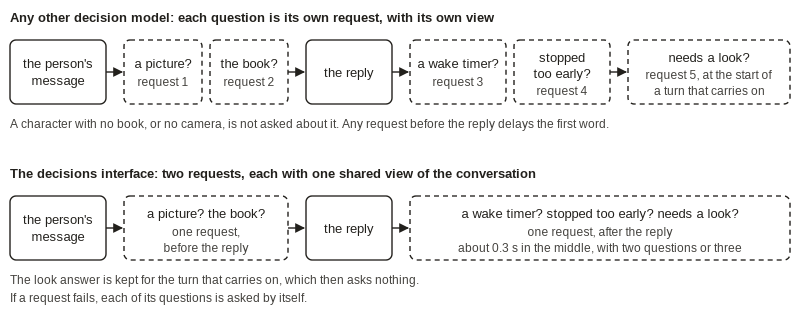
The one miss, as both characters, was "Here is a little song for you.", at 40% and 23% where carrying on needs 85%; alone, as Marlowe, it had scored 53%. Offered the wiring into Marlowe's turns, Sully chose not now, then typed "Actually I changed my mind, do it". In typed turns with Marlowe, Gemma as chat model, a request took 0.2 to 0.6 s.
we need spend tracking for cloud. token also. make the gpt6 version the default for marlowe
The page was new. It reads a ledger begun with the new repository at 12:57, so the morning's calls are not in it. It showed 870 calls to the interface, 577,075 tokens read, none from cache, $0.058: all the evening's runs. "Under a cent" was what I had told Sully of the first, 281 of those calls, without reading the ledger; what they cost was never read, and at 21:48 I said the later runs had added to it.
One request with one question was counted as 315 tokens and another with three as
974, so I said the conversation is charged once per question. Those two differ in
evidence and in questions. The timing run had sent the same evidence with 1, 4, 16
and 64 questions, and its ledger lines were never read. A Marlowe turn's two
requests cost $0.00013, against $0.00011 for an average reply from gpt-6-luna in
Sully's morning conversation.
Not shown: Gemma's 0.12 s is on an idle card. In a conversation Sully had with Marlowe that night, Gemma's 36 decisions averaged 0.38 to 0.52 s by question. No sample is longer than eight lines, so the shared view was never full. The wake-timer question has no samples.
Open#
- No turn of Sully's, spoken or typed, used the decisions interface that day; only my typed tests did. The Marlowe conversation I read at 22:38 ran on Gemma throughout, though its defaults were cloud models. Why was not found that day.
- Nothing ran on a small device or a privately hosted model; speech, listening, embeddings and memory writing stayed on the gaming PC.
- Whether instructions written for luna would keep it a bear was not tried.