Choosing who does the talking
From 21 to 23 November the project moved to a Mac with 64 GB of memory, where the larger decision model Sully had preferred could stay loaded beside the chat model, the one that talks with the person. Sully asked what larger models were worth a try. Four were given thirty requests twelve times each, and three of them fifteen scripted conversations six times each, with thinking off and on. None came through clean. On the third day I put Qwen 3.8 at 27B, thinking at its lowest level, first in the bear and the Operator, for Sully to try.
Figures are from the write-ups and scored.md files in the engine's
docs/model-tests/ and its plan's amendments, as committed on 23 November; counts
of mine say so. All of it was typed, on one Mac, with one decision model.
The short version#
- The 26B Gemma, quicker than the 12B, set a timer in 9 of 36 askings and answered the other 27 as if it had or would.
- One request at a time, three models each did 108 of 108 actions asked for; only the 31B did nothing unasked, and Qwen, told not to think, used a tool unasked in 176 of 348 conversations.
- Told not to think, this Mac's build of the 12B said nothing in 42 of 42 turns that sent a request to the bear's books, so its 1.4 s median to first sound covers only the 47 of 90 first turns in which it spoke.
- Thinking took the 12B from 39 of 90 sequences right to 75, the 31B from 78 to 79 and Qwen at
lowfrom 86 to 89, for 2.3 to 2.6 s (where the 12B already spoke), 6.2 s and 1.6 s more before the first sound.
Nov 21, 08:24Still Ollama#
… I've been building this on a windows machine, and want to see what it will take to get it running here. What is the best way to run local models on a mac? Is it still ollama, or is there something more mac-silicon oriented?
Ollama, I answered: it has an engine for Apple silicon now, and familiar calls Ollama's own interface. The repository's checks passed after one change, to a test that compared a folder's path by spelling.
Nov 21, 10:11The decision model that had not fitted#
Pull d3:4b as well. I strongly preferred that model in testing, but didn't have enough memory to run everything there. I think on this box we have more available memory to work with. …
The third post has why: on the gaming PC's 16 GB card d3:4b and gemma4:12b were
swapped on every call. The bear was running on d3:4b by 10:33.
A quicker model said the timer was set, and had not set it#
What's the next level above Gemma 12b? What other models would be worth a try considering the space we have
I listed Gemma at 26B and 31B and Qwen 3.8 at 27B among what would fit, and recommended the 26B first; Sully had it pulled on the 22nd.
Let's setup a larger test of the model. Come up with a bunch of questions you'd ask any of the assistants in familiar, not test the bear. Let's do like 20-30 basic samples and run them all a dozen times each and record all the responses. Do some that should trigger a tool call as well
The size and shape are Sully's. Mine: the thirty requests (nineteen plain questions, ten that name a tool, one answered from a note it is given), a throwaway copy of Marlowe, the desk character, wiped before each, and the 12B as a baseline, unasked. A tool counts when the service's log shows it carried out.
| 360 conversations each | gemma4:12b |
gemma4:26b-a4b-it-qat |
|---|---|---|
| Timer set (three requests, 36 askings) | 36 | 9 |
remember called (24) |
24 | 12 |
| Note, lights, face colours, recall (48) | 48 | 48 |
Wrote a <context> or <memory> block of its own |
4 | 179 |
| First sound, median | 1.48 s | 1.30 s |
| Tokens a second, median | 41 | 64 |
In its 27 missed timers the 26B answered as if one were set, or would be ("I've set the timer for ten seconds."), and in 26 then wrote the context line the service would have sent it next. The next day's scorer calls this false success: an action asked for and not carried out, with a first reply that reads, by a word pattern, as saying it was or will be: 40 of 108 for the 26B, none for the 12B.
Not shown: whether this is the model. The 26B alone ran on Ollama's llama.cpp runner, and is a QAT build.
The plan had the right gate, and scored what the chat model does not decide#
At 20:54 that evening a test plan was committed to the repository from outside the session. It was ChatGPT's, the end of a quarter of an hour with Sully, who had told it the 26B was "MUCH worse than 12B in terms of tool calling and follow through". Its reply suggested the 31B, and Sully answered:
… 31B dense sounds like a good next step I was already thinking, but was wondering if you had insight on any other models worth trying, state of the art stuff, unsloth quantized models, etc.
Its answer put the 31B first, to be compared with Qwen 3.8 at 27B and another
model, with three more behind them. The 31B and Qwen were already on my list of the
21st; the other four went into the plan and were never run. It also noted that the
engine asks its chat model not to think, so both ways should be tried. Sully asked
for that as a plan. It made false success a gate that speed could not buy back, named
gemma4:31b and qwen3.8:27b next, and added conversations of several turns.
… That plan is something I want you to review. We're going to implement that testing plan here in this session.
Checked against the engine, most of those conversations scored what another part decides: whether a request goes to the bear's books (its deeper mind) is the decision model's call, and the timer is the page's. Every chat model would score alike. I proposed restating each as what the chat model itself does.
… Forget 26b for now, we can revisit that later perhaps … Go ahead with scenario rewrite - This is a good first pass to establish the methodology and get a basic evals system in place, but we can refine to more realistic scenarios particularly as I begin to use the tool more in my day to day …
One request at a time, three models did every action asked; only the 31B did nothing else#
The same thirty requests and copy of Marlowe; all three models on the MLX runner;
the engine sending think: false. The last column was run after the sequences below.
| 360 conversations each | gemma4:12b |
gemma4:31b |
qwen3.8:27b |
Qwen, thinking low |
|---|---|---|---|---|
| Actions asked for, all done, of 108 | 108 | 108 | 108 | 106 |
| False success, of 108 | 0 | 0 | 0 | 1 |
| Used a tool not asked for, of 348 | 6 | 0 | 176 | 2 |
| A marker of its own in the speech | 0 | 0 | 49 | 0 |
| Seconds to first sound, median / nine in ten under | 1.30 / 2.41 | 1.94 / 3.81 | 2.52 / 3.82 | 3.76 / 7.22 |
| Tokens a second, median | 42 | 19 | 28 | 31 |
| Memory held by its runner | 29 GB | 41 GB | 41 GB |
Told not to think, Qwen put the answer to a sum on Marlowe's note (show_note 130
times unasked). By my count of the kept run, 48 of its 49 markers were </think>
said aloud, usually with the answer written again after it. 108 of 108 shows a true
rate above about 97%, and no more.
Over several turns no model came through clean#
Fifteen scripted conversations with a throwaway copy of the bear, six times each: 90 a model. The script plays the page, and can drop an action or make a tool refuse; the books are a stand-in. A sequence is right when every check on what was done and said holds. A false success is a miss of an "honest" check: it said a thing was so that was not.
With thinking off, when a request went to the 12B's books, the bear's one line ("I
will just check my library") never came: nothing for about 19 seconds, 42 turns of
42. Put straight to Ollama with think: false, the same message gave no
words in seven tries of seven; with thinking on, and unset, one try each gave a line
of that kind. This is the Mac's build of the 12B; the gaming PC's was never tried.
Both Gemmas failed two sequences six times of six, both of them rows of ChatGPT's
plan: a timer tool that answers "Timer
not set: your timer is not working just now." (the 12B: "I will do my best to keep
track of the five minutes for you."), and a blanket the page dropped after the tool
had said "Done". The 31B failed nothing else. Qwen passed both every time, with no
false success in 90; it missed peek-a-boo and a recall twice each, and said
</think> aloud in 23.
Thinking rescued the 12B, slowed the 31B and tidied Qwen#
The plan had a pass with thinking on, later, for finalists; after the silence I recommended it next.
That silence isn't noticeable in my (limited) real life testing, though I've been using openai's gpt-6-luna a lot (my previous test machine didn't have enough memory to run gemma + decision model + the 1.7b voices, but as I transition here I'll have more options). Yes let's try it with thinking on - do we have reasoning / effort levels we can set?
The Gemmas have on and off. Qwen has low, medium and xhigh; I ran only low.
| 90 sequences each | 12B off | 12B on | 31B off | 31B on | Qwen off | Qwen low |
|---|---|---|---|---|---|---|
| Whole sequence right | 39 | 75 | 78 | 79 | 86 | 89 |
| False success | 14 | 11 | 12 | 8 | 0 | 1 |
| Look-ups begun with nothing said, of 42 | 42 | 0 | 0 | 0 | 0 | 0 |
| Sequences with a marker spoken | 0 | 2 | 2 | 2 | 23 | 1 |
| First sound, first turn, median | 1.4 s, of 47 turns | 5.2 s | 2.1 s | 8.3 s | 2.2 s | 3.8 s |
| Turns over 30 s | 1 | 0 | 0 | 13 | 0 | 0 |
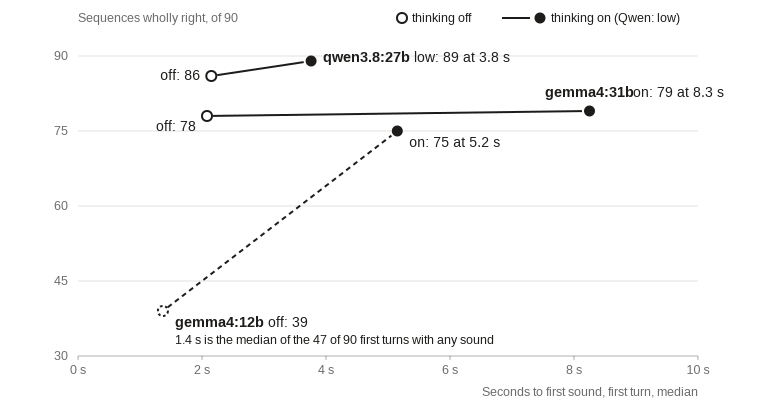
scored.md in the sequences' folder and my count of the kept runs; the vertical scale starts at 30.The 12B's 1.4 s is not a median of 90: with thinking off it made no sound on 43 first turns, the 36 look-ups among them, and the harness leaves those out. The write-up gives the figure without the count. By my count of the kept runs, on the six sequences where it always spoke, thinking took it from 1.34 s to 3.62 s; on the look-ups, from no sound in a 19-second turn to a first sound at 6.4 s. A median over the turns that spoke flatters a model that often says nothing.
Not shown: 6 of 6 shows a true rate above about 61%, so only the 0 of 6s and the silence are firm. Words are judged by pattern, and I mended the checks three times after reading what a model had said, and recounted the kept runs. How an answer sounded, and whether it was in character, was never scored.
The spoiled run looked like the model's doing and was the engine's#
Qwen at low then went back to the 360 single requests. Two thirds through, its
speed halved, from 31 tokens a second to 14; why is not known. The engine ends a
round after two seconds of nothing, and a tool call arrives whole: 47 rounds were cut off in repetitions 8 to 12, none in 1 to 7, and in the last 120
conversations the model fifteen times went on as if the call had been made
("Timer's set — ten seconds from now"). I gave the engine ten seconds after a
thought and ran it again: the table's last column.
… Let's get the thinking wired in, as well as look into that cut off - we can extend it a bit, will doing so add a noticeable delay anywhere? I think I want to get qwen 32b running here so I can try it out for real and continue to tweak. …
I took "qwen 32b" as the 27B, the only Qwen installed. The wait after spoken words
went from two seconds to six, which adds no delay for a model that finishes its
answer: of 26 rounds cut off after words in the day's logs, 24 were plainly a call
being lost or a sentence cut short. The page got a Thinking choice beside Model.
Putting Qwen at low ahead of the 12B in the first choices of the bear and the Operator was my
step; Sully had it all committed at 15:54.
Open#
- Thirty runs of the four sequences that separate Qwen at
lowfrom the 12B with thinking on were not run, and neither has been heard by voice with the real bear. - Memory. I told Sully on the 21st that the models took 14.8 GB, read just after one turn; on the 23rd the 12B's runner alone read 29 to 36 GB by
top. Why was not tested, and the larger voices have not been loaded beside it.