Where the minute went
On the morning of 27 November a note typed to the Journal was answered 74.6 seconds later. Two questions and a remark of Sully's in the four hours after it each got a measurement: how fast the local model reads a prompt, how much of what it has read is kept, and what asking a second model costs meanwhile. Between them Sully had two things built: a page that shows a deeper mind's conversation and can clear it, and a guess, shown on the Journal's page, at what its Keeper is about to do.
Figures are the two familiars' logs as printed in the session (timings and token
counts only), my scripts' output there, Ollama's log, and the two notes written that
morning in the engine's docs/mind-tests/. Nothing
Sully said to a familiar is here; lines given as said to the Journal are test lines
of mine. The day's work was committed at 11:35, while I was writing this; I read it uncommitted.
The short version#
- The Keeper's conversation had grown to 22,000 tokens in two days and 57 of them were still cached; by the later measurement, reading it again would be about 53 of that call's 63 seconds.
qwen3.8:27bread a prompt it had not seen at 436 tokens a second for 1,000 tokens and 294 for 97,000; the Operator's Claude mind read 424,000 uncached tokens that morning in 5.4 s.- A prompt of up to 47,000 tokens sent again began in 0.3 to 0.4 s in four tries of five, and one of 46,846 was read again in full; at 65,000 and 94,000 Ollama read it again in full each time, and Pi is told the model's window is 64,000.
- The decision model saw coming all 27 entries a keeper would touch, with one false alarm, on 36 lines that I wrote, labelled and tuned the questions against.
- Asked while the chat model read, the decision model's ten questions took 6.3 to 7.4 s where alone they took 2: either model alone keeps the graphics processor at 98 to 100%.
07:10Seventy-five seconds#
Commit and push, then look at the latest conversation and show me the timings
The latest was a note given to the Journal at 07:07. The decision model took 0.17 s to say it was one for the journal, and "Noted." began playing at 0.4 s. Then the Keeper (the local model behind the Journal, in the Pi harness) asked its model once, and that took 63 s: 22,038 tokens to read anew beside 57 kept, and 331 written. Its second call, nearly all kept, took 4.4 s; the Journal's voice took 6.1 s more to say so.
The Keeper had been one conversation for two days and 21 requests, given whole to the model at every call. I recommended starting it a new conversation after an idle spell, and changed nothing.
07:22A page for the mind#
Okay. For now I want to get more visibility into and be able to manage the underlying "deeper mind" conversation; another admin page that shows the current transcript, tool calls and all, with the ability to wipe it and start it fresh
I built the page in the engine, so every character with a deeper mind has it. It reads what Pi, Claude Code and Hermes each keep of a conversation into one shape: every request, every call to the model with its seconds and its tokens read, cached and written, every tool call and what came back. Mine, unasked: a call of 20 s or more, or one that read 5,000 tokens anew, is marked in red; and "Begin a fresh conversation" is the engine's own way of 22 November, which sets the old one aside where the page can still show it. Sully had said "wipe". I said so and offered a true deletion.
The first thing it showed was on the other familiar. The Operator's Exchange, which is Claude Code, held 424,000 tokens in one conversation, and at 07:30 had read 423,819 of them, none cached, in a call of 5.4 s from asking to its last word, by the times in Claude Code's own file. By 07:53 both conversations had been begun afresh from the page, by no call of mine.
07:53How fast it reads#
It's interesting how much faster the operator is, even with that massive token backlog. Those cloud services are amazing. I'm surprised 20k context slowed down the qwen model so much. What's the context limit set to right now? I cleared the conversation, ensure qwen is loaded and going then send some uncached prompts of 1k, 5k, 10k, 20k, and so on to get time to first token in the response for please
The test is Sully's design: prompts nothing has read before, those sizes, the time to the first token. I took "and so on" to 100,000. Each prompt was random words after a line no earlier prompt began with, thinking was off, and the model was loaded: no run reports a load time above 0.01 s. Ollama had it loaded with a context of 262,144 tokens, the model's most; Pi is told 64,000.
| Tokens in the prompt | Seconds to the first token | Tokens read a second |
|---|---|---|
| 1,021 | 2.3 | 436 |
| 4,933 | 10.7 | 462 |
| 9,713 | 21.8 | 446 |
| 19,421 | 46.6 | 417 |
| 38,887 | 101 | 384 |
| 58,434 | 168 | 348 |
| 97,328 | 331 | 294 |
It is all reading: Ollama's own count of the seconds spent on the prompt was within 0.6 s of each. At these speeds the morning's 22,038 tokens are about 53 s of the 63, and the rest fits the writing of 331. I told Sully 47 and wrote it in the note; that is the row for 19,421. It is an estimate either way: the Keeper asks through Pi with thinking on, which was not timed.
08:52What is kept#
Show me if the caching holds at larger tokens as well. Does a cached 50k token response go just as fast as the 20k?
Each size was sent new, then the very same again, then carried on as a conversation is: the same, its answer and about 500 tokens more. Seconds to the first token:
| Tokens | New | The same, 2nd | The same, 3rd | Carried on |
|---|---|---|---|---|
| 18,743 | 43.2 | 0.34 | not run | 1.6 |
| 28,167 | 69.8 | 0.35 | 0.34 | 1.8 |
| 46,753 | 127 | 0.40 | 0.44 | 2.3 |
| 46,846 (an earlier run) | 125 | 126 | not run | 2.3 |
| 65,361 | 195 | 192 | 174 | 176 |
| 93,672 (an earlier run) | 306 | 306 | not run | 309 |
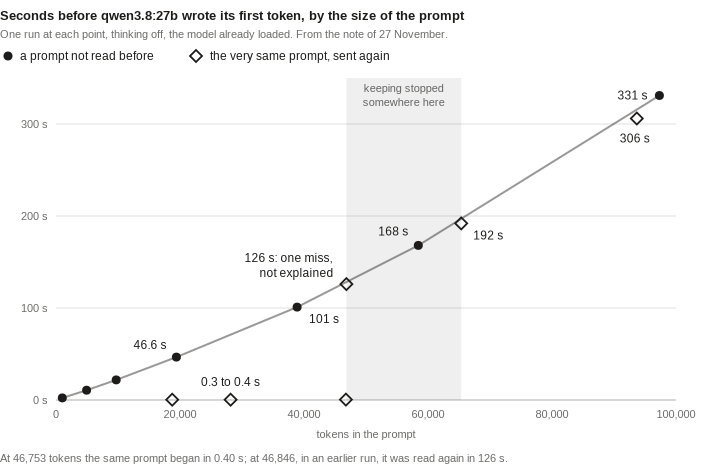
So yes at 47,000, and no beyond. Ollama's log has, for the 94,000 sent again,
matched=93671 cached=0: it knew the prompt and had kept none of it. For the 65,000
it kept at most the first 8,191 tokens. The log names no limit.
The miss at 46,846 I first put down to smaller prompts kept just before it. The later run had one too, and hit; the note has the miss as unexplained.
What follows for the Keeper: Pi's 64,000 is above where keeping stopped. A conversation let grow that far would be read again at every call, about three minutes each.
Okay. I'm not ready to make a decision about how to automate that clearing yet, I'll observe the size and manually clear for a bit to get a feel for it. Write up a note about those cache findings so we don't lose that information
I had recommended the automatic kind twice by then.
10:18Something is coming#
Excellent, now I want to try something new. For the bullet journal, I want to test out a few things. 1) remove "noted" as a spoken reply on input; silence is fine, the visual indicators are good enough; 2) while the keeper is running, let's use a decision model to assess which items are likely to be edited / updated / removed by the keeper based on the input, and also the likelihood a new item is coming - if that works out, we can speculatively show an indication on those items (or below the last item for a new thing) that something is coming
Both ideas are Sully's, and so is the condition, "if that works out". So I measured
before building: one question for each entry on the page and one for a new entry,
put to d3:4b in a single request, for 36 lines said to an invented page of nine
entries. I wrote the lines and marked what a keeper would touch.
| Entries seen coming | False alarms, of 291 left alone | New entry called rightly | |
|---|---|---|---|
| First wording, likely at 0.5 | 27 of 27 | 6 | 35 of 35 |
| Reworded once | 27 of 27 | 3 | 35 of 35 |
| Likely at 0.7 | 27 of 27 | 1 | 35 of 35 |
Not counted: one line that could go either way on a new entry, and six entries in three lines that a keeper might touch or not. The alarm left was an event picked out by "Move everything I haven't finished to tomorrow, except washing the car". The rewording and the stricter mark were both fitted to these same 36, so use should be expected to do worse.
It took about 2 s, so I built the indication, and took "Noted." out. I left "One moment.", said to a question, since Sully had named only the other.
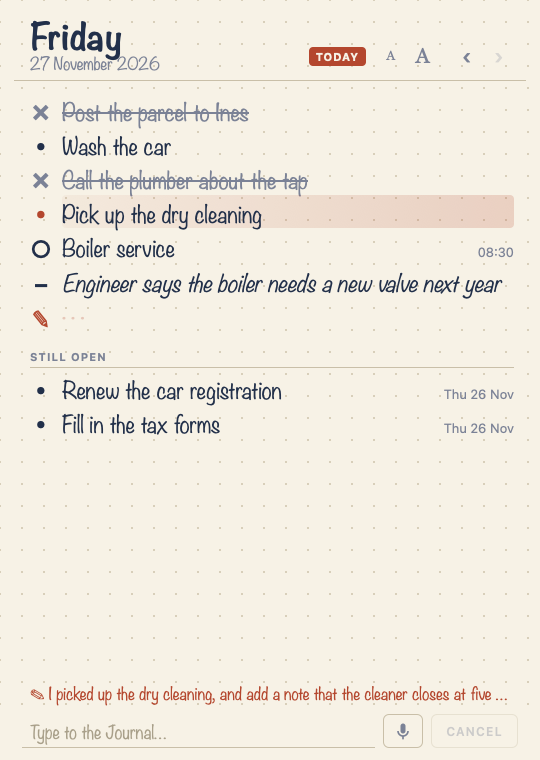
Tried on that copy, once each: with the guess made beside the Keeper, the entry was picked out 5.6 s after "I called the plumber" and marked done at 38 s. With the guess given up to 3 s to itself first, which was my choice, another line's entry was picked out at 2.3 s and the Keeper had done both at 11 s.
10:49Two models, one graphics processor#
I'm surprised running the decision model at the same time as the LLM harness saw such a performance hit
Is that an ollama issue or actual resource constraint?
| Alone | Beside the other | |
|---|---|---|
d3:4b, ten questions |
2.05 s | 6.3 to 7.4 s while Qwen reads; 2.2 to 3.3 s while it writes |
qwen3.8:27b reading 10,700 tokens |
23.9 s | 35.4 s, 35.8 s |
qwen3.8:27b writing 200 tokens |
7.4 s, 10.4 s | 9.8 s, 14.5 s |
| Graphics processor busy | 98% with d3:4b; 98 to 100% with Qwen |
Two runs. I measured on the first message, unasked; the second got the busy readings. A constraint: either model alone fills the one graphics processor. While Qwen read, five batches of questions were answered, about 10 s of work alone, and 23.9 and 10 make 34 where the two together took 35.4. Run at once they cost the sum. Ollama kept neither waiting for the other; within one model it takes requests one at a time. The busy figure is the system's own and coarse: it read 28 to 58% with nothing asked.
So the head start adds no work: it chooses what is seen first. ChatGPT's review of the 25th had said local contention remained to be measured for the early reply; this is another load, and Sully's surprise brought it.
Open#
- When a mind's conversation is begun afresh. Sully is watching its size and clearing it by hand.
- Where between 47,000 and 65,000 tokens Ollama stops keeping a prompt, and why one of 46,846 was read again.
- What is kept when a familiar's voice and its Keeper take turns on one model, as the Journal's do; and whether thinking, or the address Pi asks through, changes the reading or the keeping. Neither was tried.
- The guess has been measured on my 36 lines and seen twice on a test copy, not in Sully's use; the spoken answer after the Keeper finishes was not seen on the new code.