Eyes that stay open
Until 19 November a character saw only when a picture was taken and a model described it (the second and third posts). That morning Sully proposed a camera that stays on and states plain facts: whether anyone is there, how many, who, whether it is dark, whether someone is looking at it. And a look as a way to speak to it, with no wake phrase. By 09:01 it was a program of its own, wired into one character. Almost nothing in it had been measured against a person.
Figures are tool output in the session and the code as committed. Where my report to Sully differed, the entry says so.
The short version#
- I proposed a day of counting the program's misses; the trial was Sully's quick tests within 41 minutes, and no count of misses is in the record.
- In the one conversation I was asked to read, a look opened the listener both times Sully spoke, while every turn told the Operator its camera was off.
- I reported the cost as about 9 ms a frame with nobody in view; the next morning Sully found the machine busy at idle, with sight at 216% of a processor core in a five-second sample.
- That it can name an enrolled face rests on one reading; the record holds no second face.
Nov 19, 06:44A camera that is always on#
Great. The new thing I want to explore is a persistent vision, having the camera always on and using CV to establish some facts. For example can the camera currently see any people, how many people, are the lights on or is it dark, can it identify me specifically, can it tell when a person is looking directly at it (enabling a new way to trigger speaking to it, without even using the trigger word perhaps), and others. Don't build anything yet but brainstorm with me where and how this fits in
The facts and the trigger are Sully's. My reply gave them a shape: a program of its own, which I called sight, that holds the camera and publishes facts, so a character reads facts and never frames. On the processor, because the chat model and the voice already filled the 16 GB graphics card. For the trigger, a look together with the start of speech, since a glance at a screen would misfire.
Nov 19, 06:46Both, and by itself first#
I want them both. Right now while I'm testing the camera is on the laptop, and so is the display, so it's quite nice. The standalone program is a great idea, so I can judge many things about it before we integrate
I had asked which mattered first, look-to-talk or knowing who is there. Standalone was my proposal, with a day of counting its misses before any wiring; Sully took it and gave the reason. I named two downloads to approve.
Nov 19, 06:47Built while Sully was away#
both are fine to download, build it. I'm stepping away for a little bit, so make any decisions you need until you can't anymore and then recap for me
By 06:56 sight.py was committed and running, in a Python environment of its own
because MediaPipe brings its own OpenCV.
| Job | Model | File |
|---|---|---|
| Finding faces | YuNet, run by OpenCV on a copy of the frame 640 pixels wide | 0.2 MB |
| Telling faces apart | SFace, run by OpenCV: 128 numbers for a face | 38.7 MB |
| Where the eyes point | MediaPipe's face landmarker, up to four faces | 3.8 MB |
All three run on the processor, on at most ten frames a second. With no face in view a frame took 8 to 10 ms in that day's five readings. A fact changes only once what is seen has stayed different for a while:
| Fact | True when | Wait before it rises, and before it falls |
|---|---|---|
| Somebody is here | a face is found | 0.4 s, 3 s |
| How many | the count of faces | 0.6 s, 2 s |
| Who | a face is at least 0.363 like one it was taught | 0.8 s, 3 s |
| Looking at me | the next section | 0.3 s, 0.6 s |
| Dark | the picture's mean brightness is under 45 of 255 | 1.5 s, 1.5 s |
| Moving | the picture changes by more than 2 between frames | 0 s, 2 s |
"Moving" was my addition. Only a face counts as a person. A person is taught to it with eight pictures; it keeps the numbers, not the pictures.
Keeping no picture, and a "Wrong" button beside each fact that logs the numbers of the moment to count misses, were in the proposals Sully had read. Decided while Sully was away: every threshold and wait in the table, and that only a browser on the same machine is answered (a request naming another host got a 403). I did not look at the camera's picture; I checked through numbers and the page's text. With nobody in front of the camera it reported no face and no change in its first 144 seconds.
"Looking" is two iris offsets and two head angles, and no test knew the right answer#
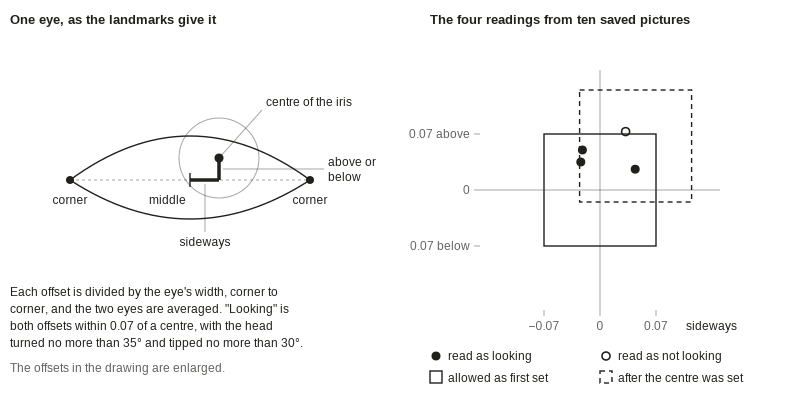
For each eye the program measures how far the centre of the iris sits from the middle of the line between the eye's corners, sideways and above or below, as a fraction of the eye's width. Somebody is looking when both offsets are within 0.07 of a centre and the head is turned at most 35° and tipped at most 30°. The irises were my proposal, put to Sully as Sully's call since they needed a download: head pose alone tells that a face is turned to the laptop, not that the eyes are on it.
Before the camera ran I tried it on the ten pictures the characters' own looks had saved, printing numbers only. Five held no face. One face was 52 pixels wide and got no landmarks, so it could never be "looking". The other four are below: three read as looking, and one missed by 0.003. I never saw the pictures, so I cannot say which of those answers were right. From the live camera the record has Sully's verdict, below, and no misread look.
Nov 19, 07:37Enough to proceed#
… overall from some quick tests it seems to work very well, definitely enough to proceed.
No face had been taught to it yet. My plan had been facts first and look-to-talk later; Sully had said both, and I took "proceed" as both. By 07:46 the Operator, a switchboard-operator character whose chat model was by then a cloud one, had three things while sight runs:
- A line with each message: who is in view, whether they are looking, whether it is dark.
- Look-to-talk: four 32 ms steps of speech in a row, while the looking fact is true, the Operator is idle and its own voice has been quiet for 0.4 s, open the listener with no wake phrase. Anybody's look counts.
- A look that takes sight's last frame: 0.04 s, timed once. With sight holding the camera a look had taken 12.82 s in each of two runs and returned a picture; my 06:56 report that it would fail was wrong.
The bear and Marlowe got the third only: with one shared camera, a look cannot say which character is meant. I told Sully that the line, with any taught name in it, now goes to the cloud model with the conversation; no picture does. My test used stand-ins for the microphone and for the look.
Nov 19, 08:02Not showing it the facts#
At 08:01 Sully had enrolled a face and asked me to read the latest conversation. A minute later, before I had answered:
Based on what I see in the UI it also doesn't appear to be showing it the facts
Each of us noticed it without the other: the cause was in my tool output ten seconds before Sully's message was typed, and when Sully first saw it is not in the record. Look-to-talk had opened the listener both times Sully spoke, 22 and 76 seconds in. But the context sent with all three turns read "Camera: it is off right now", with no line from sight. The page writes the context itself, and I had added the line only for when it sends none. I moved it into the service, reworded it, and checked by printing it with nobody in view. No conversation in the record shows it reaching the model.
Nov 19, 08:56One page to monitor#
… I want a better integration with the "eyes" - I want checkboxes to enable / disable that and the look to talk (it's in the threshold section now), I want a hook so that the UI knows when it is being looked at and can draw an indicator (for operator perhaps a faint version of its border?), I'd like to see the current state of the Facts on the page as well, so I only have one page to monitor (without losing the eyes page for registering - link it like the other pages)
All of it is Sully's, the faint border included. Each face's drawing code is now
told looked and the facts with every frame, and the Operator's stylesheet gives
its border an opacity of 0.28 while idle and looked at. The camera saw nobody, so I
drove the face by hand: the class was set, and the opacity read back was 0. No real
look is recorded lighting it.
Nov 19, 15:28To be used for real#
Restarting sight at Sully's request that afternoon, I found the Operator's "Use what it sees" box switched off in its saved settings, not by me, and asked.
I'll adjust my settings as needed, no worries there. Okay so these are all good. In order to really get a good feel for it though, I think I'm going to need to spend some time using it for real …
That became the next post, the Operator at a desk. Its settings file names sight and its face has the faint border; look-to-talk starts off there, as everywhere.
Nov 20, 08:02Busy while idle#
system resources seem to be getting heavily used even while it's idle, can you check things out
A five-second sample showed sight at 216% of one core, on a machine with 32 logical processors, and the Operator's service at 241% (the next post's). My check on the 19th was meant to read the processor too; that part printed nothing, and I reported the 9 ms. OpenCV was splitting each small frame across all 32 threads. I replayed one frame from the camera 60 times, at ten a second:
| OpenCV threads | A face in the frame | No face |
|---|---|---|
| 32, as given | 157% and 176% of a core; 13.2 and 17.6 ms a frame | 103%; 10.0 ms |
| 1 | 43% and 39%; 41.7 and 40.8 ms | 18%; 18.1 ms |
Each run fetched its own frame, and the no-face cells are one run each. Held to one thread, the running program read 28% of a core over 8 seconds and 33% over 10, with about 280 MB of memory. Nothing records what the camera saw in any of the three samples, and by the table a face more than doubles the cost. It asks nothing of the graphics card.
Nov 21, 10:11No camera here#
On the 21st the bear, rebuilt as a familiar (a later post), was started on the gaming PC with sight running, and its service gave the record's one reading of a known face: one person in view, named as the one enrolled. Fifty minutes later, on the Mac the work was moving to:
… I don't have a camera attached here. …
Sight's environment was not set up there. Through 26 November none of Sully's messages returns to it.
Open#
- How often each fact is wrong: no "Wrong" mark and no count is in the record.
- Look-to-talk while the words are for someone else, or a video plays: unmeasured. Its two firings are one person at one sitting.
- Telling faces apart: the record holds one reading of one known face and no second, so nothing in it tests the 0.363 line.
- "Dark" is plain brightness, and a laptop camera brightens a dim room itself; the line at 45 was not tried in the dark.