The Operator: a quick voice in front of a bigger mind
On 18 November Sully set out, in one message, the arrangement the rest of this log tests: a small, quick model talks, and what it cannot do goes to a bigger, slower mind whose answer it then says in character. That night it became a third character: the Operator, a switchboard operator who puts calls through to the Exchange, a Claude Code session. On its first day a fact it had just saved went to the Exchange anyway, and the Exchange sent back a wrong correction.
Figures are from test scripts' output and the Operator's log as printed in the session; the test cases are mine.
The short version#
- Whether to call the bigger mind is a yes-or-no question asked apart from the conversation, and the program places the call.
- Run as one
claude -pprocess per request, resuming one session, Claude answered four requests that needed no tool in 1.7 to 2.2 s each. - Gemma kept 16 of 16 facts in six relayed answers, and twice credited the Exchange with an answer of its own.
- Sully's fix for the saved fact, a second decision asked ahead of the first, scored 18 of 18 on my cases, one run.
- The one catch-up correction Sully reported was wrong; the reason the Exchange wrote down afterwards was a greeting I had typed as a test.
Nov 18, 19:33The front of a smarter brain#
Okay here is the next we can build into the repo - it's not exactly what my final vision will be, but it's a good step toward it. … The main thing here -- I want the familiar to be the front of a smarter brain, represented here by a Claude session. Input text comes in -- decision model thinks if it needs to be routed to the smart model or can handle it directly because it's a simple request, basic tool usage for tools it has etc. If no then it's handled directly. If yes then it gets routed to a Claude session. Once it goes idle (not actively waiting for a response) it will send any responses and the input to the smart session as well, and give it a chance to add more / do more if needed (but shouldn't always). … it can happen after a series of inputs or single input that did not trigger the thinking mode and then that's kind of like a catch-up. … when Claude is done thinking and gives an answer back then that answer should be fed back to the speaking brain that is the local model or the cloud model to be translated into the final output that maintains the character theme. Think that through with me
By then the bear's program was an engine that runs a character from a folder (another post); this was its next.
Everything quoted is Sully's, the decision model as router and the catch-up with its "shouldn't always" included. My reply added a short line said at once when a request is routed, and a test of whether a small model restating an answer drops facts. I called the catch-up "the safety net" for a weak answer, and asked four things.
Nov 18, 20:24"1 your ideas?"#
2 yes 3 okay for start 4 agree
1 your ideas?
That settled three. Everything said to it may go to Claude. Claude starts with web search and a folder of notes, and a late addition is spoken only within about 20 seconds: both my proposals. The fourth was who it is. I gave three characters, each with something natural to say during a wait, and picked the switchboard operator; "the Exchange" was my name too. Sully never chose in words, and was using both names an hour later.
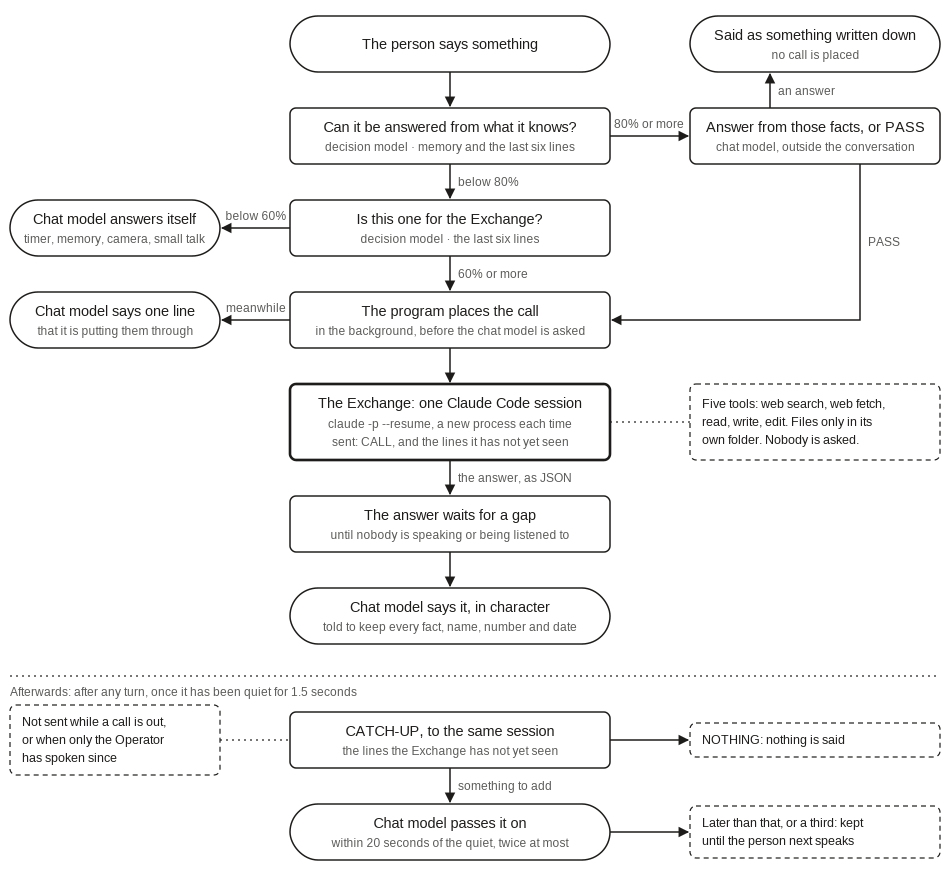
The chat model that night was gemma4:12b, also answering the decision questions
(the decisions post's stand-in). Little is left to it. A yes-or-no question
decides whether to call, at 60%. The Operator's code places the call, then tells
the chat model it is out, gives it no tools that turn and asks for one line. It is
trusted with small things (the time, a timer, memory, the camera), with a
put_through tool as a fallback, and with saying the Exchange's answer without
losing what is in it.
Two of those I measured without Claude, once, on lines I wrote. Routing: 34 of
34 (16 for the Exchange, 18 not) with gemma4:12b and with d3:2b. Restating: six
answers holding 16 facts I had marked, mostly numbers, names and dates, went
through Gemma, and all 16 came out.
Then three typed runs with a script in Claude's place. In the first the answer came
back and was never said: the engine takes three seconds of nothing from a loaded
model as a choice to stay silent, and on a nearly full graphics card the holding
line's first sound had taken 16.24 s. I freed memory and stopped timing such a
turn, both at once. I also typed that Sydney is the capital of Australia; Gemma put
it right and added "the Exchange informs me", with no call placed. I wrote a line
against that. In the second Gemma, offered no tools, wrote a put_through call
out as text; I reworded its note. In the third the holding line ("One moment
please, I'm putting you through now.") sounded at 1.99 s.
Nov 18, 21:15A line to Claude#
Claude Code was not on the machine. Offered two ways, Sully chose that I install it, then signed in. The command I had written from the documentation ran unchanged on version 2.1.328:
claude -p "<the request>" --output-format json --resume <session id>
       --system-prompt "<the Exchange's role>" --restricted
       --tools WebSearch,WebFetch,Read,Write,Edit --allowedTools <the same>
       --permission-mode dontAsk --strict-mcp-config
       --settings '{"permissions": {"blockReadsOutsideWorkingDirectories": true,
                                    "blockWritesOutsideWorkingDirectories": true}}'
Sully had said "a Claude session"; Claude Code was my choice, after first proposing
the Agent SDK. It is one process per request. The request is a command-line
argument, cut at 24,000 letters: the word CALL or CATCH-UP, then the transcript
lines the Exchange has not yet seen. JSON comes back; the service reads result
and keeps session_id for the next --resume. The role says a call is heard, not
read ("usually under a hundred words"), and that to a catch-up "nearly always the
right reply is the one word NOTHING".
| Put to Claude on 18 November | Time |
|---|---|
| Two calls and two catch-ups that needed no tool, direct from a script | 1.7 to 2.2 s each |
| One web search, direct, under a test role | 10.7 s |
| On the page, my question about heat pumps: placed to answered, by the log's clock | 3 s |
| Sully's three calls that evening, by the log's clock; the second asked for a web search, the third is the next entry's | 3 s, 22 s, 3 s |
Direct, it answered NOTHING to one catch-up, corrected another, and in its fourth request knew what the first had asked. Its limits held when tested. On the page the answer as spoken was 120 words and 41 s of speech, and to the Sydney remark Gemma said "The Exchange would tell you that Canberra is the capital of Australia." My line had not held.
Nov 18, 21:33Before it rings#
Look at the most recent conversation - I asked it in a previous session … had it record it into memory, and then asked it again, and it went to the exchange. We should have another decision as well -- can this question be directly answered from the facts in memory. At high enough threshold, overriding even the exchange check, we can do a special prompt asking the llm to answer it only if it can be directly answered from the memorized facts otherwise generate a special answer indicating no, then we connect to the exchange
Operator could be prompted to say this was on a sticky note, written down, already have that answer, etc. for this case
All of that is Sully's, the Operator's way of saying it included. Mine: 80%, the word PASS, and counting the last six lines of conversation as known along with memory. The Operator is told it had the answer "on a slip by the switchboard, in your notes, already written down, or the like".
On 18 questions over three notes I wrote, six answerable, Gemma as decision model and then as chat model was right 18 times at each step, in one run. On the page, against the Operator's real memory, I asked for the saved fact: 100%, no call, and a reply opening "I have that right here in my notes for you". A follow-up of mine on a detail the note did not hold scored 0%, then 100% for the Exchange.
the cost follow up going to the exchange was perfect actually
At 21:38 Sully asked for "bf emma as the default", a Kokoro voice, in place of two I had set unheard.
Nov 19, 05:03The safety net, wrong#
pull the latest conversation - two weird things. Did the time correction come from the claude session? Also on the second response, the new voice always says november the 19th instead of "19th of november" - marlowe does not do this
It did. The Operator had given the time, rightly, from its clock. The catch-up went out, and the Exchange replied that the clock "appears to be running on universal time" and gave the evening before. It came inside the 20 seconds, so the Operator passed it on and apologised for its clock.
The reason the Exchange wrote down afterwards, as I reported it then, was a good evening said at five in the morning. That was mine. At 04:46 and 04:57, trying a voice and then an effect, I had typed "Good evening." into the running Operator's page, and the lines reached Sully's real session. One long session remembers test lines too.
Each message now carries the local day, time and zone, and the role says that clock is right. Three times, each in a new session, I sent a catch-up I wrote round the same question, and got NOTHING. That shows little: not the old wording, not the old session with my greetings, not the same lines. I said I would test against the stand-in from then on. The date was a mishearing, withdrawn a minute later.
Nov 19, 06:31Luna for everything#
I've done some testing of the operator and am happy with it for now, I'll continue to explore. All the current defaults are fine for decisions, I'll put them through the paces as I use this more. Make Luna and Luna decisions the default for operator for everything
Luna is gpt-6-luna, the small cloud model of the memory post. It became the
Operator's chat and decision model, so from its first morning the quick voice was
not a local model. The 34, the 16 and the 18 above are Gemma's (the 34 also
d3:2b's); none was run on luna in these two days.
Open#
- Every score here is from cases I wrote, run once, and none on the model that is now the default.
- Word that comes more than 20 seconds late is kept until the person next speaks; tested only with the stand-in.
- The clock fix has no control run, and how often a catch-up says anything, or is right when it does, was not counted.