Starting the reply before the decision is in
On the morning of 25 November Sully asked me for a timeline of one reply from the Operator, then asked about the path I had left out. Half an hour later Sully proposed that the chat model begin its reply at once, while the decision model's questions are still out: held until they are answered, thrown away if they overrule it. I built it with two changes of mine: one from-memory reply where there had been two, which Sully's message took up, and the two questions asked together. In one trial, on another copy of the Operator, a typed line that had waited 3.96 s for its first sound the day before waited 1.8 s.
Figures are from the Operator's logs as printed in the session; the code is as committed that day. Each is one turn typed by me unless it says otherwise; of one turn of Sully's own I use only the timings.
The short version#
- The slowest path timed, an answer from memory, was missing from my timeline until Sully asked about it.
- A typed line's first sound went out at 1.8 s where it had been 3.96 s (one turn each, on two days and two copies of the Operator): 1.19 s of that from Sully's early reply, 0.83 s from the questions asked together, 0.14 s from a shorter reply's sound.
- The from-memory pair, 6.39 s and 3.19 s, is not a measured gain: another copy, another question, spoken against typed, and 1.5 s of it a faster decision.
- Both early replies thrown away were a model call for nothing; one had already begun the answer the second gave.
10:00A timeline of one reply#
Before the Operator replies, a decision model (terms on the Cast page) is asked two yes-or-no questions: can this be answered from what the Operator already knows, and is it one for the Exchange, the Claude Code session behind it. That morning both it and the chat model were Claude's Haiku through Claude Code: a trial with a post of its own.
On the 24th Sully had said "I'll bring my responsiveness ideas", and at 09:41 on the 25th came back to that check-in, where responsiveness was one of three items. I gave a table of times to first sound and my three ideas that still applied on Haiku, the largest being to ask the two questions at the same time. Sully asked for the ground first:
walk me through a small flow chart of what's happening, timeline wise, in the ordinary short reply, place the call itself, relaying exchange answers flows
The three names are rows of that table. I read the logs of three turns I had typed into Sully's running Operator the afternoon before, the "before" rows of the diagram below. The two questions took 2.17 to 2.35 s, one after the other, and the reply they held up about 1.2 s to write.
Reading them turned up a fault of mine: the table's 3.8 s for "It places the call itself" was the program placing the call, and the chat model placing one with its own tool has not been timed on Haiku. One thing I had left undone: on the 24th, in cold starts of Claude Code outside the Operator, one Haiku decision took a median of 1.7 s over five runs (1.6 to 3.6 s) and four at once, tried once, 1.8 s in all. I told Sully the Operator's two could be asked together and did not do it.
10:07The path I had left out#
If decisions 1 comes back true, what happens? we don't have that flow measured?
It had been timed once, and not by me: a spoken turn of Sully's at 08:15 that morning. The first question took 2.6 s and said yes. The chat model was then asked, in a separate request, to answer strictly from the facts or pass: 2.39 s, never spoken. Then it was asked again, in character, to say the answer: first sound at 6.39 s, the slowest start of any path timed. I said the answer was being written twice and the Operator could speak from the facts directly. It is one sample with a slow decision: the same question took 1.13 to 1.68 s on that log's other three turns.
10:35Two speedups#
Okay my speedups are:
a) begin generating the reply from the LLM immediately in parallel with the decision models. If the decisions come up for case 1, we play it right away. If the decision is to relay, we throw away the answer. If either decision or LLM decided to relay, we generate the "putting you through line" after the exchange is working.
b) if decisions 1 is yes (answer from memory), we can toss the LLM generated answer and reprompt it to answer from memory) including if the LLM called the exchange. We can cut to a single return from memory as the operator, I think that will likely work as you've said
"Case 1" is the ordinary reply, first in my timeline. (a) is Sully's. Mine had been to ask the two questions together, which still leaves the chat model waiting for both. The single reply in (b) is the one I had suggested at 10:07, "as you've said". What Sully added is how it meets (a): the early reply is tossed when the first question says yes, even if it had called the Exchange.
10:39What that left me to decide#
The message says an early reply the decisions overrule is thrown away. How the program tells, and what a reply already begun may have done by then, were mine to settle.
- It lives in the engine, for every character; the bear's picture and book questions were not run.
- The early request is what the turn would send if no question changed anything. When the answers are in, it is compared with what the turn would now send. If they match word for word, the early reply is the reply. If a note was added (a call is placed; you already have this), it is stopped and the model is asked again.
- Until then nothing it writes is said, shown or acted on, so a tool called in a discarded reply was never run.
- The two questions are asked at once, or the early reply would have waited 2.2 s for them.
- It is not done when one local model is both chat model and decision model, and a setting turns it off.
- From memory, the Operator is told it has the answer and gives it. If it is not there after all, it puts the call through with its own tool, where the program used to place it on the word PASS. The strict prompt ("Never guess") went with the step.
A new test runs these cases against stand-in models. Three checks failed on its first run, for reasons I did not establish, and I changed the test, not the code: one, that the chat model's request goes out before the questions, became a check on a flag in the log. So the test does not assert the order; the trial's log shows it.
10:44One run#
I started the engine's sample Operator on a port of its own, on Haiku, and typed four lines into it, once each. It is a different copy from Sully's, with a different memory, so every pair below is two copies.
| Seconds to the first sound sent | Before | After |
|---|---|---|
| Ordinary reply to "Thank you, that's all." | 3.96 | 1.80 |
| One for the Exchange: the holding line | 3.74, 3.76 | 3.09 |
| Answered from what it knows | 6.39 (spoken, another question) | 3.19 |
| The Exchange's answer, from its arrival | 2.01 | 1.93 |
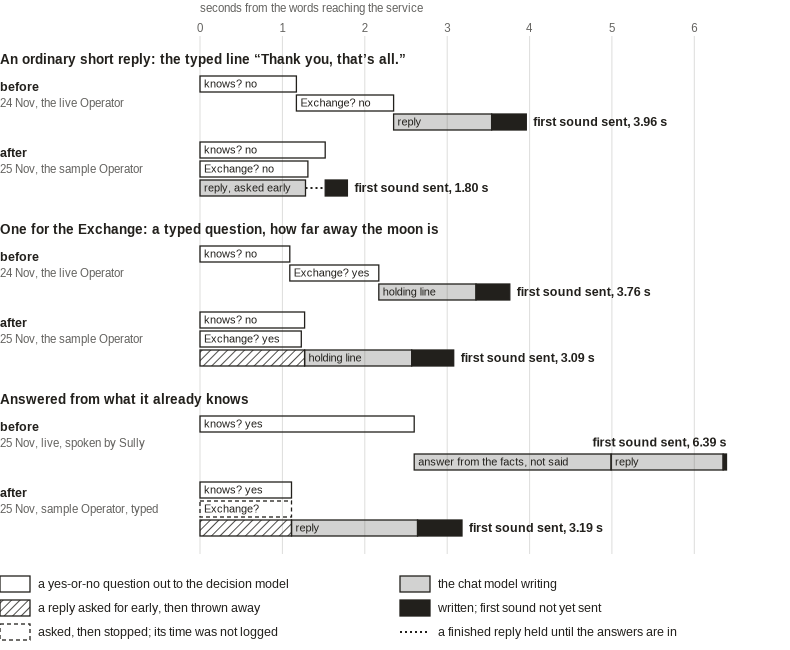
In the ordinary turn the reply, asked 1.53 s before it was taken, was finished at 1.28 s and waited until 1.52 s for the slower question: the questions now set the start. Against the day before, 0.83 s is the questions asked together, 1.19 s the reply being ready, and 0.14 s a shorter reply's sound.
The Exchange turn's first sound was about 0.7 s sooner in this run: the questions were in 0.9 s sooner, and the line and its sound took 0.24 s longer. Its early reply had written nothing in 1.28 s when it was dropped, and the holding line (Sully's "putting you through line") is still a model round.
The from-memory pair is not a measured gain. Of its 3.2 s, 1.5 s is the decision itself (1.11 s against 2.6 s); the step taken out had cost 2.39 s. The reply thrown away had got as far as "The moon is about 239,": the chat model, with the whole conversation where the old step was shown six lines, was already answering. The second said: "It's about 239,000 miles away on average, or roughly 384,000 kilometres. I had that to hand from the answer I passed on a moment ago, so there's no need to ring the Exchange again."
10:56Committed#
Okay. Let's get this all committed. This is a good improvement.
I had relaunched Sully's Operator with the changes at 10:46. At 11:05 Sully reported having tried it with the local models and made those its defaults again, which belongs to the post on those trials.
Open#
- Nothing was timed with local models, where the early reply shares the machine with the decision model; the Journal's post comes back to that.
- No "after" was taken on Sully's Operator, typed or spoken. By voice, the quiet that ends a sentence and the speech-to-text come before 0.
- An early reply that itself calls the Exchange, and a yes from the first question with no answer behind it, came up only in the stand-in tests.
- The from-memory answer lost its strict step; nothing shows how often the Operator, told it has the answer, gives one it does not have.