The Journal: a local model keeps the book
At 11:15 on 25 November Sully described a character that keeps a bullet journal by voice with nothing external in it. It is the first familiar built for a local deeper mind: the slow agent behind its voice is a local model in an open harness. It ran sixteen minutes later, and Sully used it all day and said what was wrong, most of it my program or my instructions and not the model.
Figures are script output and the Journal's log as printed in the session (timings only) and each day's code. Nothing Sully said to the Journal is here: every note quoted is an invented test line that I typed, two of them the test pack's.
The short version#
- Sully's verdict on Qwen through Pi after an afternoon of use: "a bit slow", and no "real mistakes yet".
- On two typed lines, one run each, the Keeper's answer came at 14.3 and 6.5 s after the 12:24 changes where it had taken 17.0 and 8.1; I had reported 16 to 19 s brought down to 5 to 7.
- Two utterances six seconds apart became two requests at once, and my program refused the second's
finish; the model had called it both times. - Claude Code on Haiku, tried once each way, ignored a changed role given as a resumed conversation's system prompt and followed one said in full in a request; Pi with Qwen took a changed role at its next start, in one trial.
Nov 25, 08:02A click, for every familiar#
… I just wanted to make sure we were trying to do it in a way that would apply to all my familiars, not just the desk operator. I want to make it so if you click the face, anywhere, it toggles the microphone status. … I don't always want to wait for it to stop listening on its own and I want to be able to just click it anytime it's listening to have it stop.
It went into the engine, whose window and page every familiar shares, so the Journal had it from its first minute. I chose that a click while listening sends what was said; Sully answers that at 17:58.
Nov 25, 11:15Nothing external#
At 11:08 Sully asked to revisit pack J of the mind tests: twelve journal requests in a scenario catalogue that came by a pull on 24 November, which Sully had said to settle on mocked tools first. The catalogue was ChatGPT's and its subject Sully's: on the night of the 23rd Sully had asked it to brainstorm scenarios and named some, the last of them "Another would be to do a daily logging assistant like a bullet journal". What such a journal is made of was ChatGPT's: a log of events with a page for each day, and tasks, events, notes, completions, migrations and corrections kept as different operations. I asked whether this was a test bench or something to use daily.
Okay. Here's what I'm thinking. I want to build the journal assistant as a dedicated bullet-journal / daily logging tool. No magtag or existing hardware integration, but this one I'll want to have a screen that shows the daily page as if it were a sheet from the journal. … I don't want to replicate this, but it has a lot of the ideas I want, without the todoist integration. I want to build this as a fully local model, so no external capabilities at all, so I can try this locally on my machine, side-by-side with my desk operator (both assistants running simultaneously, different wakewords). This one I will use the pi harness with qwen for since it has no outside data, much easier and safer to test it there
The cut names a daily-log program of Sully's own, from which I took how a day's page reads. The character, its limits, the harness and the model are Sully's; the names (the Journal, the Keeper, "Hey Journal") are mine, and so are the tools as code, on the catalogue's model.
The Keeper is Pi, the open harness of the mind tests, kept running with
qwen3.8:27b under Ollama at low thinking, the model that also does the Journal's
talking. It has seven journal tools, none of Pi's own, and finish, the tool of
the finish-tool post: an answer reaches the voice only through that call, and Pi is
told to stop when it returns. The voice cannot touch the journal: a decision model,
d3:4b, is asked whether what was said is one for the journal, and the engine
hands it over.
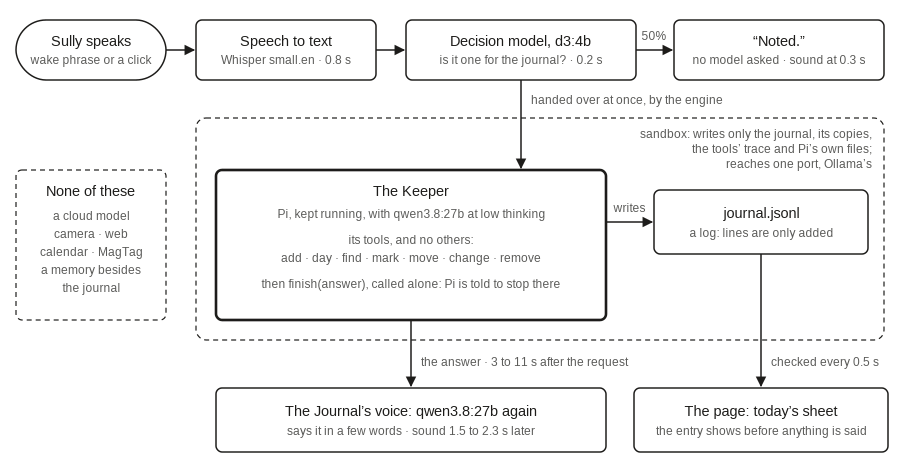
My first typed try waited 75 seconds and failed: the sandbox did not let Python read the engine's folder, so the tools program could not import the journal module beside it. Six typed lines then went as I expected.
Nov 25, 12:16What a spoken note cost#
okay check the timings on the journal convo - i guess some of this was qwen startup time
Sully had by then asked which speech-to-text model was in use (Whisper base.en)
and chosen to try small.en: 0.97 to 0.99 s against 0.31 to 0.33 on one
11.7-second clip.
| Spoken turns, from the Journal's log | After a quiet spell | The first conversation |
|---|---|---|
| Speech to text | 0.78 s, small.en |
0.24 to 0.28 s, base.en |
| The decision | 0.77 s | 0.23 to 1.17 s |
| "Noted.", written by the voice model: first sound, after the words arrived as text | 10.4 s | 3.0 to 9.4 s |
| Entry written, after the decision (the Keeper's trace, whole seconds) | 26 s | 16 s, a traced write |
| The Keeper's answer, after the decision | 28.1 s | 15.9 to 19.0 s, the refused request below apart |
| Confirmation's first sound, after the answer | 4.7 s | 2.9 to 4.9 s |
Some was startup, I took it then: the voice's round took 8.8 s against 2.5 to 3.0 on the first conversation's later turns (7.7 on its first), thirteen minutes after the Journal's last start, and Ollama by default drops a model after five. Nothing saw the model unloaded: my search of Ollama's log found no line, and the Operator shares the model. The rest was not startup: in the writes traced, all but two or three seconds of the Keeper's time passed before the entry was written. Voice and Keeper share one model and began together, and the early reply of the latency post was dropped on every turn in the log, since nearly everything goes to the Keeper. That the sharing was the cause is my reading; nothing isolated it.
The log also held two utterances six seconds apart, probably one sentence cut by
the pause detector, that became two requests at once. The model called finish
for each; the second was refused as coming after its request was over. A mind's
requests are now taken one at a time. To answer Sully I read that log, which holds
what was said: the Journal sends nothing out, but the session that builds it is a
cloud model's.
Nov 25, 12:24Loaded, no early reply, "Noted."#
i definitely want qwen to stay loaded. We can turn off early reply for the journal, and say "Noted" on exchange transfer there (I like operator as it is). I have an idea for the interrupted speech / multiple utterances, as it's something I definitely want to try and improve and one of my biggest pet peeves of any kind of speech to text system that isn't controlled by a button
All three were on my list at 12:19; Sully took them for the Journal, and the Operator gained only the keep-loaded line. Both models now stay loaded: by Ollama's listing, 21 GB of Qwen and 5.9 of the decision model at 12:32, 29 and 5.9 at 15:18. "Noted." is now said by the program; "One moment.", for a question, is my addition.
| Typed, one run each, about 11:27 and at 12:29 | Acknowledgement, before | after | Keeper's answer, before | after |
|---|---|---|---|---|
| "Need batteries; also we had a great game night." (first after a start) | 6.5 s | 1.9 s | 17.0 s | 14.3 s |
| "I bought the batteries." | 2.4 s | 0.33 s | 8.1 s | 6.5 s |
| "What's still open?" | 2.9 s | 0.35 s | 7.8 s | 4.6 s |
I reported the Keeper's answer as gone from "16–19 s" to "5–7 s": spoken turns on the real Journal beside typed ones on an empty copy. The table is the nearest to like-for-like the record holds: three changes at once, the later runs on a copy, and the third row asked sixth with three tasks open before, second with one after.
Nov 25, 15:11It read the note back#
With the journal, it nearly always repeats back the full note to me. Since I'm nearly always looking at the log and see it live, I'd like it to shorten its final response. "Okay I've put that note on your list" or "Got it, those corrections are in now" etc.
It had been told to. My role for the Keeper asked for "one or two plain sentences saying what you did", and the batteries line had got "Batteries is on today's tasks, and the great game night is noted." I rewrote both roles around Sully's examples. With the real Keeper's conversation carried over, the Keeper still wrote 45 to 91 characters for each of five writes, and the voice cut them to as little as "Done." I suspect its history of long answers; untested.
Nov 25, 16:08No real mistakes yet#
Okay. Qwen is still a bit slow when going through the harness, but it's working out pretty well. In general it hasn't made any real mistakes yet. Tell me about the underlying format for the journal, how durable it is, etc.
The journal is one file of JSON lines, only ever added to. I listed its weak points: a single copy, ids taken from a count, a delete that rewrote the file in place. And one false statement of mine: the Keeper was told to say a deleted entry was gone, while its words stayed in the tools' trace, the Keeper's conversation and the logs. Sully took the three fixes and settled the fourth: "I don't want to scrub, just make the keeper say it's out of the journal".
Nov 25, 16:25Windows a familiar can open#
I gave two ways to open more windows. Sully took the second, a window opened from inside the face, and made it one a familiar's mind opens:
Option 2 is what I'm thinking. for example I'm envisioning adding a tool where the desk operator could open a file into a dedicated window for me, or even an embedded browser that it controls. And for the journal I'm thinking of a diff view for journal changes that could popup if a decision model rated the change as risky or wrong or something. … I don't want it to open in the system editor, but in a window the app controls and could move, close, etc.
Only the file window was built, for the Operator. At 16:50 Sully reported a file written and no window. My wording showed a file only when asked to "show" it, and the Operator's Exchange, which is Claude Code, had never received the new role. Tried once each with Haiku on a resumed conversation, a changed role was ignored as the system prompt, appended to it, and pointed to from the request; said in full at the head of a request, it was followed. Pi with Qwen, in one trial, used a word added to its role at its next start.
Nov 25, 17:58Abort#
I need a way to abort a message in progress - in the same way right now I can click to stop listening and it transmits, you are right that I also need some way to say "abort and stop listening". The button right now is a very large text input box, that could easily be replaced with a smaller chat window that has a popup text input (auto-focused, enter submits and closes) and then some additional buttons there perhaps?
Built as Sully sketched it: a strip with a line that opens a box to type in, and Cancel, which throws away what was heard, during transcription too.
Nov 25, 22:04The page, by hand#
For the journal, I want to change the click handling. I don't want the entire page to be a click to enable microphone, one small speaker icon at the bottom near the chat input will do there. Instead I want to be able to click the items to interact with them. clicking the text of any should make it editable; click the item to perform a context sensitive action (close task, not sure about the others), clicking empty space left of an item allows for flagging it important (and give the tool for this)
These writes go to the file with no model asked, so from here the Keeper is the only model that writes the journal, not the only writer. It got an eighth tool, to flag.
Nov 26, 08:22Done with new features#
Okay. I'm done with new features for now let's return to our hardening and scenarios. Where are we there.
My answer: none of pack J was in the test runner, and "the tool surface was settled by use and there are no measured numbers for it". The pack was first run after this message, in the next post.
Not given entries: window placement, a heading and foot that hold still, a text size, and no listening after a typed message.
Open#
- Not measured: a spoken turn after 12:24 (Sully's "a bit slow" at 16:08 is the record), whether
small.enmishears less, "Hey Journal" for false wakes, two familiars on one microphone. - The journal test tries one refused write in the sandbox, not its network rule.
- The clicks, Cancel and the strip were worked by script only.
- Sully's idea for utterances split by a pause has not been told.
- A trial of mine at 15:16 ran on a copy of the real journal, and a read-back from it reached my session.